Wednesday, October 5, 2022

Monday, January 29, 2018
The China market for mutton. An update.
China demand has pulled record numbers in mutton imports, particularly in the last quarter of 2017.
Overall China meat import data broken into major categories shows the sharp rise in values and volumes of mutton imports in 2017.


Australian mutton production reached 172,201 tonnes Jan-Nov 2017, a rise of 10.6% on the same period in 2016 (155,626 tonnes). That is almost an additional 17,000 tonnes. Mutton exports to China surged in Oct-Dec 2017 with a rise of 264%; a lift in exports from 5,468 tonnes Oct-Dec 2016 to almost 20,000 tonnes Oct-Dec 2017.


Overall China meat import data broken into major categories shows the sharp rise in values and volumes of mutton imports in 2017.

First a look at New Zealand. NZ annual sheep slaughter in season 2015-2016 was 3,793,597 head, down 5.6% on the previous year of 4,019,779 head. Sheep slaughter dropped a further 6.4% in 2016-2017 season (3,551,842 head). To week 12 of season 2017-2018, sheep slaughter is up 10.9% to 1,303,244 head. As week 12 is the festive season, slaughter dropped back. Against that, New Zealand has shipped record volumes of mutton to China in the last quarter of 2017 according to Agri HQ market intelligence and based on New Zealand exports stats.


In relation to China mutton imports, the data available from a Hong Kong source shows estimated 2017 annual mutton and goat meat imports of 241,000 tonnes at a value of US$849.2 million. This compares with 220,063 tonnes in 2016 calendar year at a far lower value of US$573.9 million. If these estimates are correct, China mutton and goat meat values have increased 47%. Historical data collated by MLA show annual Chinese mutton imports as follows from 2000 calendar year.

China has resumed its demand for mutton after imports eased for two years 2015,2016. However the exponential growth in import values in 2017 augers well for demand.
If we look at China mutton retail and wholesale prices, we see mutton retail prices have increased from 60.7 Yuan per kg in September to 64.98 Y per kg in December 2017. In wholesale prices, September 2017 reported mutton at 47.92 Y per kg and this increased to 52.80 Y per kg in December 2017, a lift of 10%.
Thursday, September 21, 2017
Food security and new evidence
A new journal article reviewed today after an AMIC news release sheds valuable light on the matter of global livestock production, food security and differing production systems.
Livestock: On our plates or eating at our table? A new analysis of the feed/food debate
The new articles indicates a wider perspective of global livestock production and its contribution to improved food security. It notes the differing production systems and low resources and land impact of grass fed and extensive grazing regimes as practiced in many parts of Australia and New Zealand. "And while some of the global discussion on food security may address the question of the feed/food competition, it often fails to mention the diversity of animal diets around the world and the various levels of efficiency in production systems"
in 2006, FAO released a study called Livestock's Long Shadow. This release saw a stream of articles and studies portraying negative aspects of livestock production on the environment.
From 2009, research conducted at UC Davis countered the arguments and narrative of some of the earlier research and media reports. This useful presentation format published by Frank Mitloehner details the research. " it is simply not true that consuming less meat and dairy products will help stop climate change, says a University of California authority on farming and greenhouse gases."
The debate continued to rage and further articles in 2014, 2015 and 2016 pushed the notion of the negative of meat production systems and climate change.
In 2014 an article entitled "Livestock and global change: Emerging issues for sustainable food systems" noted some research has led to "inaccurate simplifications of the messages surrounding how to manage the livestock sector’s growth in the future." and "The benefits associated with livestock are societal, economic, and environmental. Livestock contribute 17% to the global food balance, in terms of calorific intake per person per day, and 33% of the protein in human diets"
An encouraging article appeared in 2015 noting that "Australia is ‘free to choose’ economic growth and falling environmental pressures" and "extensions of current policies that mobilize technology and incentivize reduced pressure account for the majority of differences in environmental performance." "results show that Australia can make great progress towards sustainable prosperity, if it chooses to do so." CSIRO also published this paper. "Australian National Outlook 2015 report"
FAO document Food Security and global efforts and publish updates and data. Recent website link notes: "There is more than enough food produced in the world to feed everyone, yet 815 million people go hungry."
In very brief summary, negative articles continue to be published and promoted by anti agriculture and protein groups. The basis of the research and quotes are selective and are largely erroneous and industry should be vigilant for further promotion of anti meat diets and seek to counter the myths espoused with sound research and factual information.
A range of Australian research:
Climate Clever Beef - climate clever beef B.NBP.0564_Final_Report January 2014
Measuring methane in the rumen under different production systems as a predictor of methane emissions B.CCH.6210
Development of gas selective membranes for intra-ruminal capsules - Department of Agriculture Ref No 01200 B.CCH.6220 August 2015
Enteric methane mitigation strategies through manipulation of feeding systems for ruminant production in southern Australia
Lead organisation: Department of Environment and Primary Industries, Victoria
01200017-project-fact-sheet_southern-feeding-systems_b-cch-6460_final
Sunday, August 13, 2017
Australian lamb consumption and perspective
There is current discussion about changes to lamb specification and it occurred to me to write up a story on some history of lamb and sheepmeat consumption in Australia. The key issue is the continued decline in lamb consumption to estimated current levels of 8.9 kilograms per head and 57% of carcase lamb production being exported.


In the 1973 ABS Yearbook, the section on agriculture and rural Australia contained the following statement: "in 1959-60, consumption of mutton and lamb at 103 lb per head of population, exceeded that of beef and veal for the first time on record." That is equivalent to almost 47 kgs per head. The graphic above indicates lamb consumption in 1972 at 54 lbs or 24.4 kgs per head of population. Exports as a percentage of production were only 12%. Current exports of lamb are highly successful and Australia attracts premiums and leading market position in many Asian countries as well as a major supplier to USA and Canada. While past glories of lamb consumption and promotion on the domestic market in Australia are behind us, it is our opinion that any change in lamb specification is unwise and could risk lamb's appeal in growing export markets and the very important home market in Australia.
Wednesday, June 14, 2017
Saudi Arabia meat trade review
According to the WTO, meat and edible offal of poultry was the most important agriculture import to Saudi Arabia in 2015.




USDA projects Saudi imports of ready to cook weight of broiler will be 790,000 tonnes in 2017. Saudi Arabia is the third largest importer after Japan and Mexico.
Australian trade in red meat is displayed in below graphic. Carcase mutton is the largest component of the trade following by offal and beef. Australian chilled lamb exports exceed frozen lamb exports to Saudi Arabia and chilled beef exports from Australia are about half frozen beef exports.

The USA was re-admitted to supply Saudi Arabia with beef in July 2016 after being banned for 4 years. Below graphic is FAO OECD projection of Saudi Arabia production by meat type:

FAO is projecting a higher level of poultry imports than USDA and a steady increase going forward. Sheep meat imports are forecast at 125,000 tonnes carcase weight in 2017, with beef imports 185,000 tonnes.
Saudi Arabia imported around 15,000 tonnes of goat meat according to UN Comtrade figures in 2015 with a value of US$79 million.
Saudi Customs and Statistics figures for February 2017 showed imports of chilled beef from Australia of 107 tonnes. The graphic below shows Brazil is the largest chilled beef supplier.

our preliminary work indicates no USA chilled or frozen beef was imported by Saudi Arabia in February 2017.
Frozen imports of beef are again headed by Brazil.

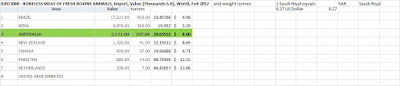
India was the second largest supplier of frozen bovine meat in February 2017 and priced at similar levels to import values of Australian frozen beef. Brazilian frozen beef import tonnage was 2,148 tonnes at a unit value of US$3.75 kg. Australia was third in line behind India and Pakistan in imports of fresh chilled lamb carcases into Saudi Arabia in February. Ethiopia was 4th ahead of New Zealand. Australia was the largest supplier of fresh bone in sheep meat in February out of only two suppliers, with New Zealand a way back. Australia supplied almost double that of New Zealand in terms of frozen sheep meat carcases.

New Zealand was the largest supplier by value in bone in frozen sheep meat cuts in February 2017.

Thursday, June 8, 2017
Australia, India, Brazil - April 2017 beef exports snapshot
We have the Indian, Australian and Brazilian bovine meat export numbers for April 2017 and it provides an interesting snapshot of how the competition is shaping up early part of this shipping year.
India is well ahead with over 97,000 tonnes of frozen buffalo shipped in the month of April. Mostly boneless in cartons. Range of specifications.


India is well ahead with over 97,000 tonnes of frozen buffalo shipped in the month of April. Mostly boneless in cartons. Range of specifications.

Brazil is next with over 70,000 tonnes in April 2017, down 16,000 tonnes on the same month in 2016.

Australia is ranked third in tonnage in April 2017, with just under 67,000 tonnes in the month of April 2017, a sharp correction in volume exported of almost 18,000 tonnes due to reduced cattle supplies and record prices in Australia.

What is most interesting is the unit values per kg in USD. Total Indian buffalo unit value in April was US$2.86 per kg. This compares with Brazilian fresh frozen beef export unit value of US$4.16 per kg in April 2017. There is a notable rise in unit value in Brazil for fresh frozen beef of 11% compared with April 2016. Australian unit value for total beef exports are estimated from ABS trade figures and April 2017 beef and veal shipped weight and comes to US$6.01 per kg. All these figures are comparable as they generally refer to FAS or FOB ports of export. The total value of beef/bovine exports is also of interest, with India running at US$278 million in April, Brazil $403 million and Australia almost level with Brazil on lower volume at US$402 million.
We have also estimated some key market unit values for Australia based on import market statistics in the key markets of Japan, USA and Korea. Japan leads in unit value per kg at US$6.99 per kg.
Brazilian figures by key markets are not available for April 2017, however Jan-Apr 2017 is available in this link.
We have a preliminary estimate of USA fresh, chilled and frozen beef exports to all destinations in April 2017 of US$468 million. Our estimate of total fresh, chilled and frozen beef export volume for April 2017 is 70,000 tonnes. Unit value per kg is calculated as US$6.78 per kg.
Monday, June 5, 2017
Australia USA beef imports in selected Asian countries
Malaysia is a key market in Asia and the second largest market globally for Indian buffalo exports.
 Malaysian import statistics for the first 3 months of 2017 show Australia supplied MYR 72.4 million and, on current exchange rates, this amounts to almost $17 million USD of beef. North American beef supplies were minimal at MYR $173,000.
For the 2 months in 2017 available for the Philippines, Australia supplied USD$8.8 million for beef and USA USD$4.2 million.
The third market examined was Thailand. In 2017 Australia supplied USD$13.4 million for beef and USA USD$3.4 million.
WTO trade graphic

For the 2 months in 2017 available for the Philippines, Australia supplied USD$8.8 million for beef and USA USD$4.2 million.
The third market examined was Thailand. In 2017 Australia supplied USD$13.4 million for beef and USA USD$3.4 million.
Subscribe to:
Posts (Atom)